
We value your privacy

We use cookies to enhance your browsing experience, serve personalized ads or content, and analyze our traffic. By clicking "Accept All", you consent to our use of cookies.

Customize Consent Preferences

We use cookies to help you navigate efficiently and perform certain functions. You will find detailed information about all cookies under each consent category below.

The cookies that are categorized as "Necessary" are stored on your browser as they are essential for enabling the basic functionalities of the site. ... 

Always Active

Necessary cookies are required to enable the basic features of this site, such as providing secure log-in or adjusting your consent preferences. These cookies do not store any personally identifiable data.

No cookies to display.

Functional cookies help perform certain functionalities like sharing the content of the website on social media platforms, collecting feedback, and other third-party features.

No cookies to display.

Analytical cookies are used to understand how visitors interact with the website. These cookies help provide information on metrics such as the number of visitors, bounce rate, traffic source, etc.

No cookies to display.

Performance cookies are used to understand and analyze the key performance indexes of the website which helps in delivering a better user experience for the visitors.

No cookies to display.

Advertisement cookies are used to provide visitors with customized advertisements based on the pages you visited previously and to analyze the effectiveness of the ad campaigns.

No cookies to display.

  • HOME
  • ABOUT US
  • LANDLORDS
    • Why Choose Us?
    • Cashflow 
    • Changes
    • Property Prep
    • Compliance
    • Legal Changes
  • PRICES
    • Additional Services
    • Inventories
  • TENANTS
    • FAQs
    • Householder Duties
    • Central Heating
    • Washing Machines
    • Condensation
  • PROPERTIES
  • CONTACT US
  • HOME
  • ABOUT US
  • LANDLORDS
    • Why Choose Us?
    • Cashflow 
    • Changes
    • Property Prep
    • Compliance
    • Legal Changes
  • PRICES
    • Additional Services
    • Inventories
  • TENANTS
    • FAQs
    • Householder Duties
    • Central Heating
    • Washing Machines
    • Condensation
  • PROPERTIES
  • CONTACT US

Central Heating

Combi “Boiler Pressure”

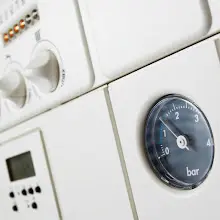
Most “Combi” boilers have a small dial indicating the circulating pressure in the radiators.

The pressure should be set to 1.5 bar (while cold).
We’d advise maintaining at this level and not allowing the pressure to drop much below 1 bar.
This should be a tenant’s responsibility.

Pressurising is normally done using a “filling key” or filling loop.

Where a filling loop is present (often a braided hose) there are normally two filling valves (one at either end of the filling loop).
Ordinarily these should BOTH be kept closed (to prevent the system leaking and becoming over-pressurised)

To re-pressurise, open one valve first (this should have no effect on the pressure).
The second valve should then be opened carefully and used to adjust the pressure – generally to 1.5 bar. The valve should then be closed.
Importantly, the other valve should also be closed to ensure no seepage.

If the boiler loses pressure significantly within a couple of weeks, this should be reported and may require to be checked by an engineer.

Radiator “bleeding”

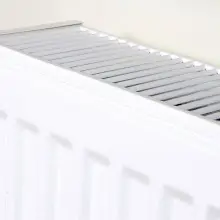
“Bleeding” is the term used for releasing air which may become trapped in a radiator.

Radiators should be periodically checked for air.
If air is present, the affected radiator(s) should be “bled” using a radiator key.
This should also be a tenant’s responsibility.
This should be done when the system is cold and properly pressurised (as above).

Boiler pressure needs to be checked before-hand and maintained during this process – then adjusted afterward – as “bleeding” will reduce the circulating pressure. If the pressure falls too low air will not be expelled – or in some cases may even be drawn in !
If significant air accumulates in a radiator, this may be evident when the top does not heat up fully and may be noticeably cooler than the lower portion.

Bleeding simply requires the “bleed valve” to be opened with a radiator key
while holding an absorbent cloth or similar underneath to catch any water which may be released when all air is expelled.

If no air is present, the valve will simply release water.

If air is present, this will be expelled (with a hissing sound).
When the valve starts to “sputter” and water starts to come out, simply close the valve.
Once the boiler has been re-pressurised, the task is complete.

You should be mindful to adjust the boiler temperature (for tap water and radiators) to allow for seasonal variation.

Tayside
© 2023 Rosemount Property LARN1905017
  • Follow
  • Follow
  • Follow
v5.0     |      Website Site powered by The Brainer